projects
Village basketball and new forms of rural development
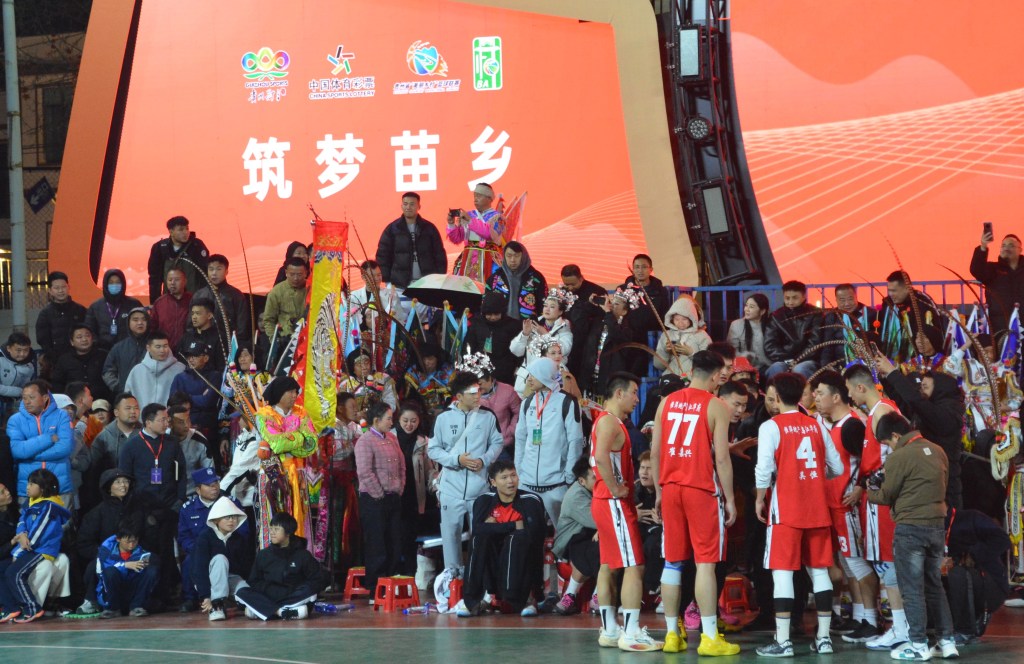
A current book project of mine is based on a study in rural Guizhou Province (Taijiang County), where amateur “Village NBA” tournaments have become a massive tourist attraction and topic of online content. “Village NBA” has been influential throughout China in shaping a model of rural tourism and place branding that is strongly based on grassroots online production. My work discusses how this model shifts away from more rigid state agendas of urbanization and rural industries new forms of value production through the deployment of local cultural identities.
Self-improvement and capitalist virtues in China and beyond
Much of my work has dealt with activities and values of self-improvement (along with the near-synonyms self-development, self-realization, self-help) as they have expanded worldwide in tandem with market economies. In China, I spent long periods in programs in positive psychology and public speaking, where young people seek to develop personalities and qualities that overcome the effects of public education, state institutions, and family structures. In many other societies, self-improvement is similarly combining elements of social critique while adjusting to changing economies. While examining these meanings of self-improvement in regard to social ethics, my anthropological lens also highlights how people participate in self-improvement programs for temporary relief and empowerment within their everyday routines, rather than following any clear path of “transformation.”
Transient Becoming: Self-Improvement and Capitalist Virtuousness in Contemporary China. National University of Singapore Press
Self-Development Ethics and Politics in China Today: A Keyword Approach. Amsterdam University Press (edited volume)
Workshop: “Capitalist Virtue Ethics?: Ethnographic explorations”, University of Cologne, June 2023
“Becoming Role Models: Pedagogies of Soft Skills and Affordances of Person-Making in Contemporary China.” Ethos 49 (2): 135-51
“Zheng Nengliang and Pedagogies of Affect in Contemporary Urban China.” Social Analysis 65 (1): 23-43
Psychology, self-help, and ethnonationalism
In recent years, my critical interest in modern psychology has shifted from an attention to individualism and citizens’ self-reliance to the ways psychological expertise interacts with politics. This is increasingly evident today in many locations with the rise of illiberal movements, and the ways ideas of emotional vulnerability and trauma are used to express superiority, exceptionalism, and suspicion. I am not simply interested in how psychological concepts are being “manipulated” for political ends (by governments, political movements, influencers) but also how the emphasis on psychologized emotionality is shaping political visions. I plan to extend this research beyond China to comparative perspectives.
“The Psychological Imagination of the Social in Contemporary China.” Emotions and Society 7 (1): 98–115
“Speaking the China Dream: Self-Realization and Nationalism in China’s Public-Speaking Shows.” Continuum 33 (1): 37-50
Psychological counseling and self-help in China
I undertook my first research project through fieldwork in Jinan in 2010-11, following the Chinese state’s drastic promotion of psychological counseling and knowledge across state and public institutions. I visited various psychology centers and met counselors, students, and enthusiasts. Most of them regarded psychology as an indispensable expertise for connecting themselves and society with so-called universal human truths, while they also reflected on tensions between the knowledge they were promoting and local behavioral norms. Rather than simply distracting people from social problems in favor of their own self-responsibility (a focus often described in the critical literature), psychological expertise has played a dominant role in making sense of social change in China and defining ideals that correspond to the image of the urban middle-class.
“Evading Chronicity: Paradoxes in Counseling Psychology in Contemporary China.” Asian Anthropology 15 (1): 68-81
“‘Developmental’ Therapy for a” Modernised” Society: The Sociopolitical Meanings of Psychology in Urban China.” China: An International Journal 15 (2): 98-119

